
Board narrative
The company is behind on AI and moving too slowly.
Assessment tests whether the root issue is AI readiness, data quality, workflow fit, governance, leadership ownership, or delivery capacity.
Assessment
Nimble CTO helps boards, executives, investors, founders, and technology leaders understand what is actually happening before they invest, reorganize, replace leadership, scale a platform, or commit to an AI roadmap.
Narrative to evidence
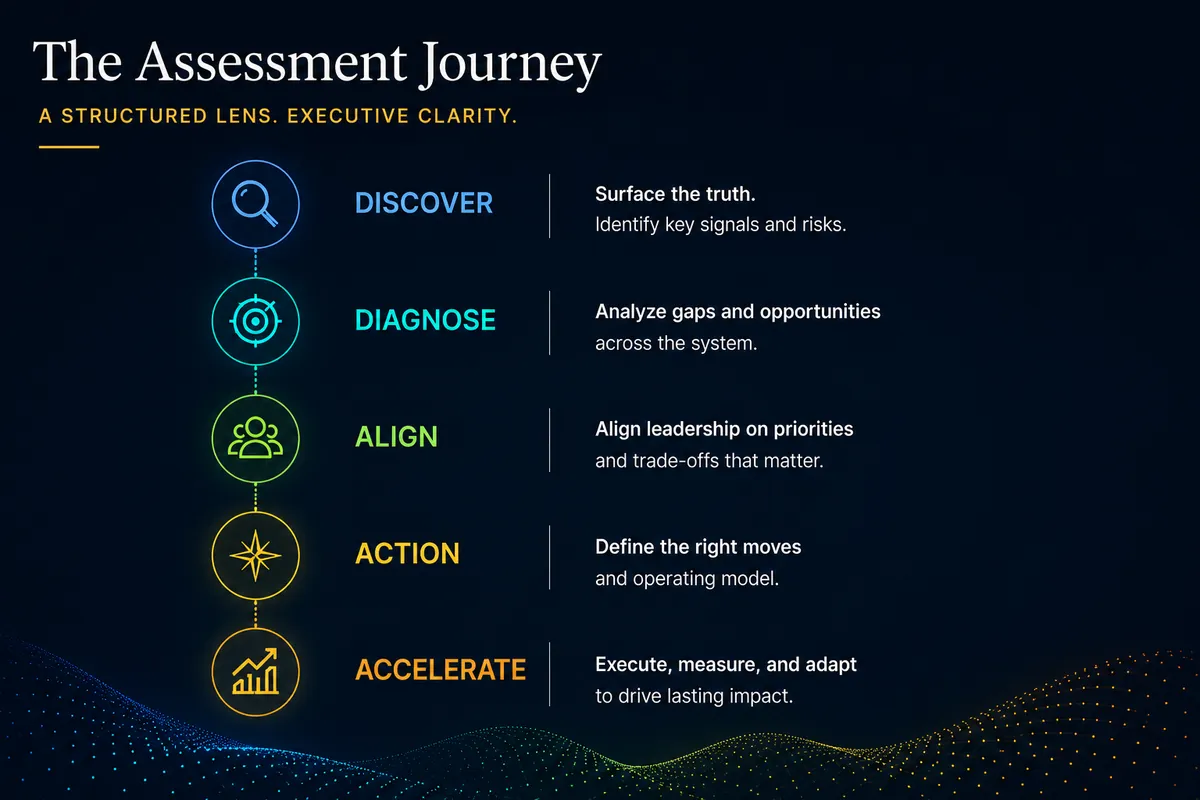
The work starts by separating narratives from observable evidence. From there, the leadership team can decide what requires clarity, alignment, execution, or scale.
Competing narratives
The most expensive decisions often begin with two plausible narratives. The work is to find the evidence underneath them.
Board narrative
Assessment tests whether the root issue is AI readiness, data quality, workflow fit, governance, leadership ownership, or delivery capacity.
Leadership narrative
Assessment tests whether the issue is leadership capability, decision rights, operating cadence, organizational design, or unclear priorities.
Scaling narrative
Assessment tests architecture, reliability, observability, technical debt, team dependency, and the business consequence of platform risk.
Why and what get assessed
Boards, executives, investors, operators, product leaders, and technology leaders can all be describing the same situation from different vantage points. Assessment creates the shared fact base across six domains before the next significant decision is made.
Leadership
Clarity on who owns priorities, trade-offs, escalation, and executive communication.
Technology
A practical read on scalability, technical debt, security exposure, observability, and continuity.
Delivery
Evidence on predictability, sequencing, dependency management, support load, and customer impact.
Data
A view of whether the business can trust the data needed for operations, reporting, and AI.
AI
Assessment of business fit, workflow change, governance risk, owner model, and measurable outcomes.
Governance
Decision rights, review cadence, risk ownership, board visibility, and proof of progress.
Assessment Types
Each assessment path uses the same evidence-first discipline. The difference is the decision the evidence must support.
For investors, boards, acquirers, lenders, founders, and leadership teams evaluating technology risk, scalability, leadership, execution capability, and investment readiness.
For CEOs, boards, and operators deciding whether technology leadership, decision rights, team maturity, or executive cadence needs to change.
For leadership teams that need a practical view of architecture, platform, reliability, security, data, debt, and scale constraints.
For organizations that need evidence on delivery predictability, roadmap credibility, dependencies, ownership, support load, and customer impact.
For teams deciding where AI can create measurable outcomes and what must be true across data, workflow, governance, ownership, and adoption.
Outcomes
Assessment is not valuable because it creates a report. It is valuable because it changes what leaders can see, prioritize, align around, and execute.
Start an Assessment
If the current story is unclear, contested, or expensive to guess at, start with an assessment conversation.